
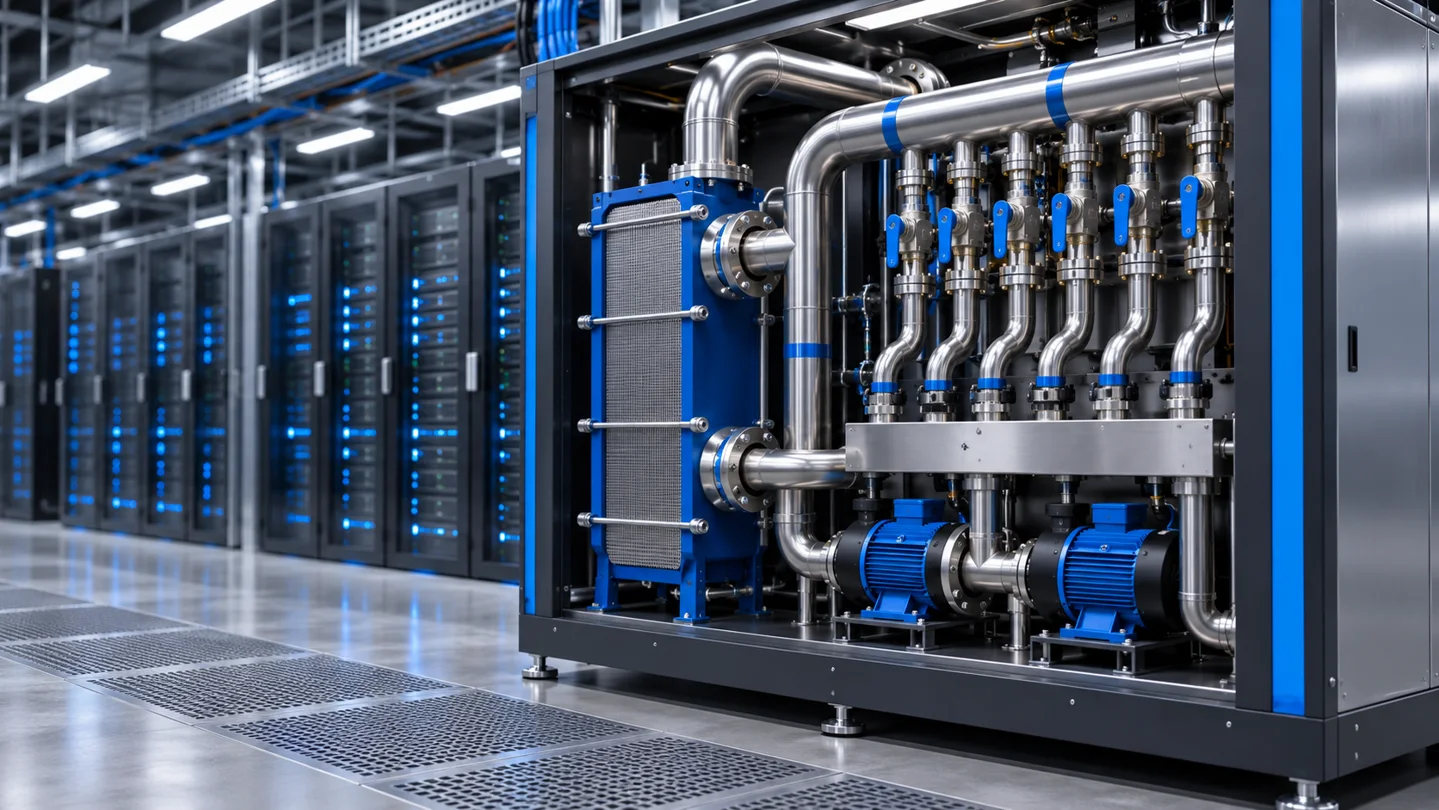
A data center liquid cooling coolant quality checklist starts with the coolant specification for the cold plates, coolant distribution unit (CDU), and the rest of the technology cooling system (TCS). A fluid approved for one rack generation may have a different allowable chemistry or filtration requirement in another. Ask suppliers to state their limits in writing before the loop is filled.
Separate the facility loop from the technology cooling loop
In an indirect liquid-to-liquid CDU design, the heat exchanger transfers heat between the facility water system and the TCS. Identify which side each sample, filter and measurement belongs to. A facility water report alone does not establish that the fluid circulating through the cold plates meets IT equipment requirements.
What belongs in a CDU coolant quality checklist?
| Check | What to record | Decision it supports |
|---|---|---|
| Fluid specification | Approved formulation and concentration range, plus the specified measurement method | Whether a delivered batch matches the equipment specification |
| Wetted materials | Metals, seals, hoses and quick disconnects with supplier compatibility statements | Whether a substitution requires engineering review |
| Chemistry and cleanliness | Supplier limits for pH, conductivity and particulate contamination where applicable | Whether to accept a commissioning sample or investigate a deviation |
| Filtration | Element rating, rating method and clean baseline pressure drop at a documented flow | How to distinguish filter loading from changes in flow or fluid temperature |
| Sampling and ownership | Sample point, temperature, time, method, acceptance criteria and named owner | Who reviews results before the loop is released to service |
Set a baseline before bringing the racks online
- Reconcile the CDU and server supplier requirements. If their approved fluid ranges conflict, record the discrepancy and obtain a written resolution.
- Agree on the cleaning, filling and sampling procedures with the commissioning team. Record the fluid batch and any approved make-up fluid.
- Record the commissioning sample and hydraulic baseline together. Note the operating flow, fluid temperature and filter condition so future readings can be compared on a consistent basis.
- Assign responsibility for reviewing results after maintenance or a fluid top-up. Record what changed and which measurements were repeated.
How to interpret a change in filter pressure drop
Suppose the commissioning record shows 12 kPa across the clean element and a later reading shows 20 kPa. Compare flow and fluid temperature first. If they differ, you cannot attribute the full change to filter loading. At comparable conditions, check the agreed filter differential-pressure limit, sampling history and recent maintenance before deciding what to inspect. The numbers here illustrate a comparison and are not alarm settings.
For hydraulic context, see Velotech’s guides to CDU filter pressure drop and CDU pump selection for data centers. Bring both the clean-filter and expected loaded-filter operating cases to the pump review.
Which reference should a project team use?
The Open Compute Project Cooling Environments resource library lists cold-plate loop and liquid distribution guidance. Its modular technology cooling system white paper gives design context for water-based TCS loops. Use the applicable equipment documentation and project specifications for acceptance criteria.