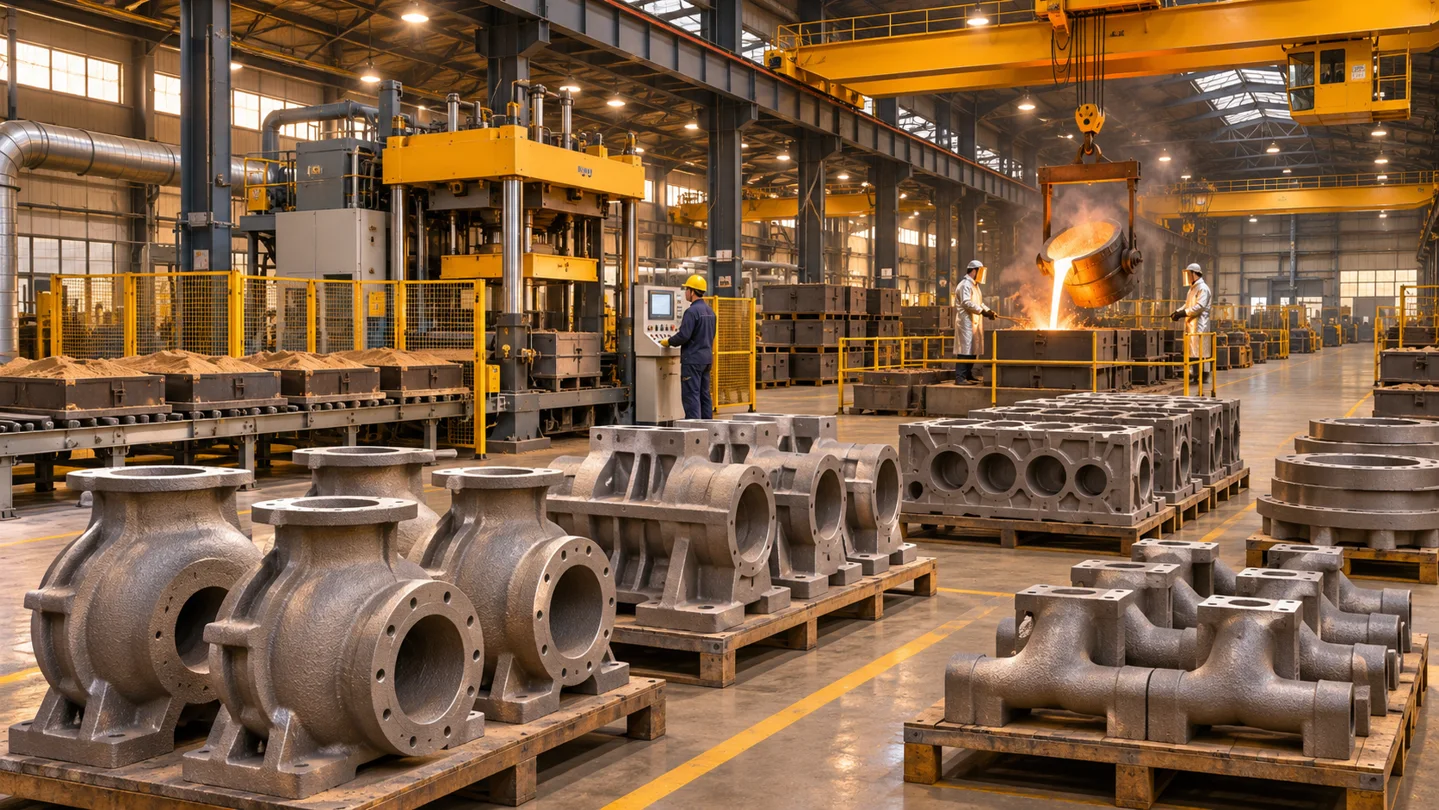
Foundry ERP production scheduling turns customer due dates into a plan for molding, melting and pouring, shakeout, finishing and inspection. The first question is which resource limits shipments this week. A furnace may have enough capacity while a shared finishing cell is already fully booked.
Build the schedule around the constrained operation
Give each casting family a routing with setup time, run time, eligible equipment and a working calendar for each operation. Record tooling and material availability alongside the hours. If two orders need the same pattern at the same time, available molding capacity alone will not make both jobs feasible.
- Molding: Capture pattern and core box availability, changeovers and realistic molds per hour.
- Melting and pouring: Group jobs by compatible alloy and capture heat size, planned pour windows and furnace availability.
- Finishing: Plan shared shot blasting, fettling, machining or inspection as separate steps where they can delay shipment.
- Outside work: Reserve time for supplier lead times and transport when heat treatment or machining is subcontracted.
Worked example: 6.5 hours of work and 5.5 hours available
Assume one finishing cell has an eight-hour shift. Breaks and planned maintenance take 1.5 hours. Another job has already reserved one hour. That leaves 5.5 hours for these two orders.
| Order | Good pieces | Cell rate | Setup | Time required |
|---|---|---|---|---|
| A | 120 | 30 per hour | 0.5 h | 4.5 h |
| B | 60 | 40 per hour | 0.5 h | 2 h |
The orders require 6.5 hours. The plan is one hour over capacity. If A ships first and B can run in two blocks, the remaining hour today covers B’s setup plus 20 pieces. The other 40 pieces need one hour tomorrow if the setup can be retained, or 1.5 hours if it must be repeated. If splitting a lot disrupts traceability or creates a quality risk, reserve the complete two-hour block on the next available shift instead.
How yield changes the upstream requirement
If a job needs 120 acceptable castings and the planning yield at the earlier casting stage is 90%, the target before that loss is 120 ÷ 0.90, rounded up to 134. Keep that piece yield distinct from metal yield, which tracks the share of poured metal remaining in castings. Check whether material, tooling and downstream inspection can support the revised quantity.
What to ask for in a foundry ERP demo
Use real routing data for a two-order scenario like the example above. Ask the vendor to show the cell’s remaining hours, a rejected attempt to overbook the same pattern, and how a late heat changes the finishing schedule and shipment promise. Then check whether the updated plan retains heat and lot identifiers.
Prepare your sample data with Velotech’s foundry ERP requirements checklist, heat-to-shipment traceability guide and scrap and rework tracking guide. For an ERP reference, see Microsoft Learn’s finite capacity planning overview. The American Foundry Society research program provides broader metalcasting industry context.