
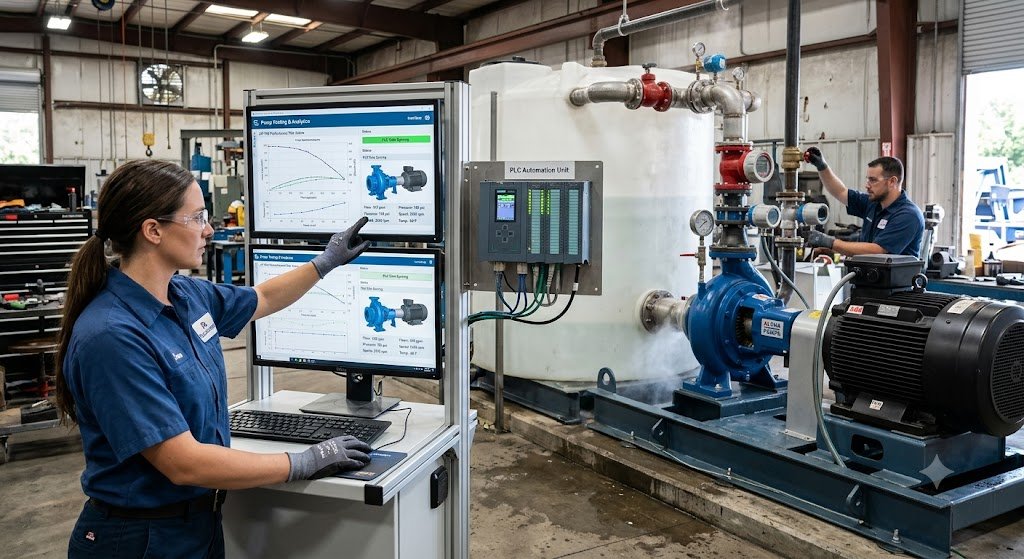
Pump testing software and PLC automation are transforming how manufacturers measure pump performance, manage quality control, and document factory testing results. As industrial operations demand more consistent testing procedures, reliable measurements, and traceable documentation, automated pump testing systems are becoming an important part of modern manufacturing workflows.
Traditional pump testing can involve manual readings, handwritten observations, spreadsheets, and repetitive data entry. Although these methods can be effective when carefully managed, they may introduce transcription errors, inconsistent recording intervals, and additional administrative work.
By connecting test-bed instrumentation, programmable logic controllers (PLCs), and digital software, manufacturers can improve data collection, standardise testing procedures, and generate more consistent performance documentation.
At Velotech Solutions, pump testing software and PLC automation form part of a specialised engineering software portfolio designed for industrial pump manufacturers.
In this comprehensive guide, we explain how pump testing software and PLC automation improve accuracy, productivity, efficiency, reporting, and quality assurance in manufacturing.
What Is Pump Testing Software?
Pump testing software is a digital system used to collect, process, display, analyse, and document performance measurements obtained during pump testing.
Manufacturers use pump testing to evaluate whether a pump meets specified operating requirements.
Depending on the pump type and testing procedure, important parameters may include:
- Flow rate
- Total dynamic head
- Suction and discharge pressure
- Pump rotational speed
- Electrical input power
- Shaft power
- Pump efficiency
- Temperature
- Vibration measurements
- Net Positive Suction Head (NPSH)
Modern pump testing software can consolidate measurements from multiple instruments into a common interface.
This helps engineers review pump performance, identify deviations, and document results more systematically.
However, software accuracy depends on the quality of instruments, calibration, installation, test procedures, and calculations. Automation alone cannot guarantee accurate measurements.
What Is PLC Automation in Pump Testing?
A Programmable Logic Controller (PLC) is an industrial controller designed to operate machinery and equipment through programmed logic.
In pump testing facilities, PLC systems can coordinate parts of the test sequence and exchange data with connected instruments and supervisory software.
Depending on the installed equipment and configuration, PLC automation may support:
- Pump motor control
- Valve operation
- Instrument signal acquisition
- Test sequence coordination
- Motor speed control through variable-frequency drives
- Operating-condition monitoring
- Alarm handling
- Equipment interlocks
- Communication with supervisory software
For example, a configured PLC may help coordinate pump operation while sensors measure pressure, flow, speed, and other parameters.
These measurements can be transferred to software for display, analysis, and reporting.
Safety-related functions require appropriate risk assessment and engineering design. A standard PLC should not be assumed to replace a dedicated safety controller or independently engineered protective system.
How Pump Testing Software & PLC Automation Work Together
A connected pump testing system typically brings together five important components.
1. Pump Test Bench
The test bench provides the physical arrangement required to operate the pump under controlled conditions.
Depending on the installation, it may include piping, valves, a reservoir, instrumentation, and suitable electrical equipment.
2. Measurement Instruments
Flow meters, pressure transmitters, power analysers, speed sensors, and other devices collect physical measurements during testing.
Instrument selection and calibration are essential for reliable results.
3. PLC and Control Panel
The PLC communicates with connected devices and coordinates the programmed operating sequence.
The control panel may also contain motor starters, drives, communication modules, and protective equipment.
4. Pump Testing Software
The software receives and processes measurement data, allowing engineers to monitor test conditions and review performance calculations.
5. Digital Reports and Records
After testing, results can be organised into reports containing measured values, calculated parameters, test conditions, and relevant acceptance criteria.
The actual capabilities depend on the configured system and available interfaces.
10 Benefits of Pump Testing Software and PLC Automation in Manufacturing
1. Improved Measurement Consistency
Consistent data collection is essential for reliable pump testing.
In manual workflows, measurements may be recorded at slightly different moments or operating conditions.
Connected instrumentation and software allow readings to be captured according to a defined procedure.
This can improve consistency between test runs.
Manufacturing benefit: More repeatable data collection and easier comparison of pump performance.
2. Reduced Manual Data Entry
Manually transferring readings from instruments into spreadsheets or reports takes time.
It also creates opportunities for transcription mistakes.
Automated data acquisition reduces the need for repeated manual entry when instruments are properly integrated.
Manufacturing benefit: Less administrative work and fewer opportunities for data transcription errors.
3. Real-Time Monitoring of Pump Performance
A connected testing system can display live measurements during a test.
Engineers may review parameters such as:
- Flow
- Pressure
- Speed
- Power
- Head
- Efficiency
This helps the test operator understand how the pump is performing under different operating conditions.
Manufacturing benefit: Faster visibility into test conditions and potential abnormalities.
4. Better Pump Performance Curve Analysis
Pump performance curves show the relationship between operating parameters.
Common examples include:
- Flow versus Head (Q-H)
- Flow versus Efficiency (Q-η)
- Flow versus Power (Q-P)
These curves help engineers understand pump behaviour across the tested operating range.
Software can organise recorded points and produce performance graphs using agreed calculation and presentation methods.
Manufacturing benefit: Easier technical evaluation of pump performance.
5. More Standardised Testing Procedures
Manufacturers may need to test numerous pump models and production units.
A structured digital workflow can help establish consistent procedures for test preparation, measurement capture, review, and reporting.
For example, engineers can define:
- Pump identification and specification.
- Test conditions and operating points.
- Required measurement parameters.
- Acceptance criteria.
- Report requirements.
Manufacturing benefit: Greater procedural consistency and improved traceability.
6. Faster Report Preparation
Manual report generation often involves copying measurements, preparing performance curves, and formatting technical documents.
Pump testing software can help organise this information into predefined reporting formats.
A configured report may include pump identification, test date, measured values, calculations, performance curves, and acceptance observations.
Manufacturing benefit: Reduced repetitive documentation work.
7. Improved Quality Control and Traceability
Pump manufacturing quality teams need reliable records to understand whether tested units meet agreed specifications.
Digital records can make it easier to associate test data with:
- Pump model
- Serial number
- Customer order
- Test operator
- Date and time
- Test conditions
- Inspection records
When properly implemented, these records can support technical reviews, quality audits, and investigations.
Manufacturing benefit: Better access to historical testing information.
8. Support for NPSH Testing
Net Positive Suction Head (NPSH) is an important concept in pump engineering.
NPSH testing may be required to understand pump suction performance under specified operating conditions.
A suitably configured testing system can support measurement collection and documentation for NPSH-related procedures.
However, NPSH testing requires appropriate instrumentation, test arrangements, procedures, and calculation methods.
Manufacturing benefit: Structured collection of specialised test information where the necessary hardware and procedures are available.
9. Potential Integration with Other Engineering Systems
Manufacturers often use separate applications for pump selection, manufacturing, quality management, and business operations.
Connecting suitable systems can reduce duplicated data entry and improve information flow.
For example, a pump testing workflow may exchange relevant information with:
- Pump selection software
- ERP systems
- Production records
- Customer documentation systems
- Quality management applications
Such integration depends on available APIs, communication interfaces, access permissions, and implementation requirements.
Manufacturing benefit: Better coordination between engineering and operational workflows.
10. Improved Operational Efficiency
A properly designed automated test workflow can reduce repeated manual activities and improve the organisation of testing operations.
Potential benefits include:
- Reduced time spent recording measurements
- Faster access to performance data
- More consistent reporting
- Easier review of historical results
- Reduced dependence on manual document preparation
- Better coordination of testing activities
These benefits depend on system design, test-bed instrumentation, staff training, and the nature of the testing process.
Manual Pump Testing vs Automated Pump Testing
| Parameter | Manual Testing | Automated Testing |
|---|---|---|
| Data Collection | Operator-recorded readings | Connected instrument acquisition |
| Monitoring | Individual instruments | Centralised live display |
| Data Entry | Manual recording | Potentially automatic |
| Report Preparation | Spreadsheet or manual documents | Configured digital outputs |
| Performance Curves | Manually prepared | Software-generated |
| Traceability | Paper or separate records | Structured digital records |
| Procedure Consistency | Dependent on operators | Supported by programmed workflows |
| Initial Investment | Often lower | May require integration investment |
| Maintenance | Instrument and procedure upkeep | Hardware, software and calibration upkeep |
Both methods can produce accurate results when the equipment, measurement process, and personnel are appropriately managed.
The primary advantage of automation is that it can improve workflow consistency and reduce repetitive manual operations.
Understanding Pump Testing Standards: ISO 9906 and ANSI/HI 14.6
Pump performance testing is guided by recognised technical standards.
ISO 9906:2012
ISO 9906:2012 addresses hydraulic performance acceptance testing for rotodynamic pumps, including centrifugal, mixed-flow, and axial-flow pumps.
It defines test procedures and acceptance grades used to evaluate hydraulic performance against specified guarantees.
Testing must follow the applicable standard requirements and agreed acceptance criteria.
ANSI/HI 14.6-2022
ANSI/HI 14.6-2022 addresses hydraulic performance acceptance testing for rotodynamic pumps.
It includes procedures and acceptance criteria relating to performance testing, NPSH, hydrostatic pressure testing, data recording, and reporting.
Why Testing Standards Matter
Standards provide a framework for consistent measurement procedures and technical evaluation.
However, using pump testing software does not automatically establish compliance with ISO or ANSI/HI requirements.
Compliance depends on the complete testing arrangement, instrumentation, measurement uncertainty, calculations, documented procedures, and acceptance conditions.
Manufacturers should confirm the applicable standard, edition, and contractual requirements before conducting acceptance tests.
Key Performance Parameters in Pump Testing
Understanding the measured and calculated parameters is essential for interpreting test results.
Flow Rate
Flow rate represents the volume of liquid passing through the pump per unit time.
Common units include cubic metres per hour (m³/h) and litres per second (L/s).
Total Dynamic Head
Head represents the energy transferred to the fluid per unit weight, expressed as an equivalent height of liquid.
It is calculated using the appropriate pressure, velocity, and elevation measurements.
Power
Power measurements help engineers understand the energy required to operate the pump.
The distinction between electrical input power and mechanical shaft power is important when calculating efficiency.
Pump Efficiency
Pump efficiency is calculated by comparing hydraulic output power with mechanical shaft input power.
For water and other suitable fluids:
Hydraulic Power (W) = Density × Gravity × Flow Rate × Head
Pump Efficiency (%) = (Hydraulic Power ÷ Shaft Input Power) × 100
Accurate efficiency calculations require consistent units and suitable measurement methods.
NPSH
NPSH is used in assessing suction conditions and the risk of cavitation.
Specific NPSH test procedures should be selected according to the pump application and applicable standard.
Applications of Automated Pump Testing Systems
Industrial Pump Manufacturing
Manufacturers of centrifugal and other industrial pumps can use structured testing workflows to evaluate performance and prepare technical documentation.
Water Supply and Infrastructure
Pump testing helps assess equipment intended for water supply, irrigation, and infrastructure applications.
Fire Protection Pump Manufacturing
Fire pump testing may involve specialised regulatory and certification requirements. Applicable fire-pump standards must be considered in addition to general pump testing methods.
HVAC and Building Services
Pump testing supports the assessment of equipment used in chilled-water, heating, and building-service systems.
Oil, Gas and Process Industries
Specialised pump applications may require additional testing procedures, instrumentation, and acceptance criteria.
Pump Testing Laboratories
Independent testing facilities can benefit from structured measurement acquisition and consistent technical report formats.
Common Challenges in Pump Test Bench Automation
Implementing an automated testing system requires more than installing software.
Manufacturers should evaluate several important factors.
Instrument Compatibility
Existing sensors and instruments may use different signals, protocols, and communication interfaces.
PLC Compatibility
PLC models, programming environments, and communication requirements should be reviewed before integration.
Measurement Accuracy
All relevant measurement instruments require suitable calibration and installation.
Electrical and Mechanical Safety
Control systems must account for equipment protection, operating limits, electrical hazards, and emergency procedures.
Testing Standards
The test bench must be designed and operated according to the standards and procedures relevant to its application.
Operator Training
Engineers and operators should understand both the software workflow and the underlying measurement principles.
Pump Testing Software & PLC Automation by Velotech Solutions
Velotech Solutions provides specialised engineering software for pump manufacturers and industrial organisations.
Its Pump Testing Software & PLC Automation offering focuses on connecting pump test-bed instrumentation, automation requirements, performance review, and digital reporting into a structured workflow.
Key Capabilities Listed by Velotech
PLC Automation
Coordinate PLC panel and software requirements around the agreed testing workflow.
Connected Instrumentation
Capture measurements from compatible instruments through configured system connections.
Live Readings
Display relevant pump testing information during operation.
Performance Testing
Review measured values and required performance outputs.
NPSH Testing Requirements
Discuss specialised NPSH testing arrangements, instrumentation, calculations, and reporting.
Test Reports
Prepare documentation using agreed fields and reporting formats.
System Integration
Explore connections with pump selection software and ERP applications where supported by the available interfaces.
The exact functionality, instrument compatibility, and integration scope must be confirmed for each installation.
How Velotech’s Pump Testing Workflow Can Be Configured
Velotech describes a structured approach based on four stages.
Step 1: Prepare the Test
Identify the pump, applicable procedure, required readings, and testing conditions.
Step 2: Capture Measurements
Acquire data from the connected instruments through the configured PLC and software interfaces.
Step 3: Review Performance
Evaluate the collected measurements and calculated outputs against the agreed test criteria.
Step 4: Prepare Documentation
Generate the configured test documentation for technical review and recordkeeping.
This approach can help manufacturers organise pump testing activities while retaining flexibility for different equipment configurations.
Why Consider Velotech Solutions for Pump Testing Automation?
For manufacturers planning to modernise existing pump testing facilities, the most important requirement is a solution suited to their actual equipment and operating procedures.
Velotech Solutions offers a specialised software approach that allows manufacturers to discuss:
- Existing PLC and control panel arrangements
- Instrumentation and measurement requirements
- Pump model and testing procedures
- Required performance outputs
- NPSH testing requirements
- Report formats
- Potential integration with other business systems
Rather than assuming every test facility requires the same setup, the implementation scope should be defined around the existing infrastructure and technical requirements.
Explore Velotech Pump Testing Software & PLC Automation:
https://velotechsolutions.com/pump-solutions/pump-testing-software-plc-automation/
How to Get Started with Pump Testing Automation
Manufacturers interested in an automated testing system can begin with these steps.
- Document the existing pump test-bed arrangement.
- Identify the pump types and testing procedures.
- List the installed instruments and PLC model.
- Define the required performance parameters.
- Determine the applicable testing standards.
- Prepare sample test reports.
- Identify software integration requirements.
- Review electrical and operational safety requirements.
- Discuss the technical configuration and implementation scope.
- Plan validation, calibration, training, and ongoing maintenance.
Request a demonstration from Velotech Solutions to discuss your pump testing requirements and available integration options.
Frequently Asked Questions
1. What is pump testing software?
Pump testing software collects, processes, displays, and documents performance measurements from pump testing equipment.
2. How does PLC automation improve pump testing?
PLC automation can coordinate equipment operations and data acquisition according to configured procedures, helping improve workflow consistency and reduce repetitive manual tasks.
3. Can automated pump testing improve accuracy?
Automation can improve measurement consistency and reduce transcription errors. However, overall accuracy still depends on instrumentation, calibration, installation, and testing procedures.
4. What parameters are measured during pump testing?
Common parameters include flow rate, head, pressure, power, speed, efficiency, and, where required, NPSH-related measurements.
5. What is an automated pump test bench?
An automated pump test bench combines physical testing equipment, sensors, control hardware, and software to support structured pump performance testing.
6. Does pump testing software support ISO 9906?
Software can be configured to support procedures and calculations relevant to ISO 9906, but compliance must be assessed for the complete test system and agreed acceptance requirements.
7. Can existing PLC systems be integrated with new software?
Potentially. Compatibility depends on the PLC model, communication interfaces, instrument specifications, and implementation requirements.
8. Can pump testing data be integrated with ERP software?
Yes, integration may be possible where suitable software interfaces, data access, and permissions are available.
9. What is NPSH testing?
NPSH testing evaluates specified suction performance characteristics of a pump under controlled test conditions.
10. Where can manufacturers find pump testing software in India?
Velotech Solutions offers pump testing software and PLC automation services for manufacturers seeking connected test instrumentation, performance review, and structured reporting.
Conclusion
Pump testing software and PLC automation can improve manufacturing efficiency by connecting instrumentation, standardising data collection, supporting performance analysis, and simplifying technical documentation.
From live measurement capture to digital reporting and test workflow coordination, automation offers practical opportunities for modern pump manufacturers.
However, reliable testing still depends on calibrated instruments, suitable procedures, competent engineering, and the correct application of technical standards.
For organisations planning to upgrade their pump testing facilities, Velotech Solutions offers a specialised engineering software approach that can be configured around specific testing requirements.
Discover Pump Testing Software & PLC Automation by Velotech Solutions and take the next step towards a more connected manufacturing workflow.
Website: https://velotechsolutions.com/
Product Details: https://velotechsolutions.com/pump-solutions/pump-testing-software-plc-automation/
Email: marketing@velotechsolutions.com
External References and Technical Resources
- ISO 9906:2012 – Rotodynamic Pump Hydraulic Performance Acceptance Tests
- ANSI/HI 14.6-2022 – Rotodynamic Pump Hydraulic Performance Acceptance Tests
- Hydraulic Institute – Pump Industry Resources
- International Electrotechnical Commission – Electrical and Automation Standards
- National Institute of Standards and Technology – Measurement Science